
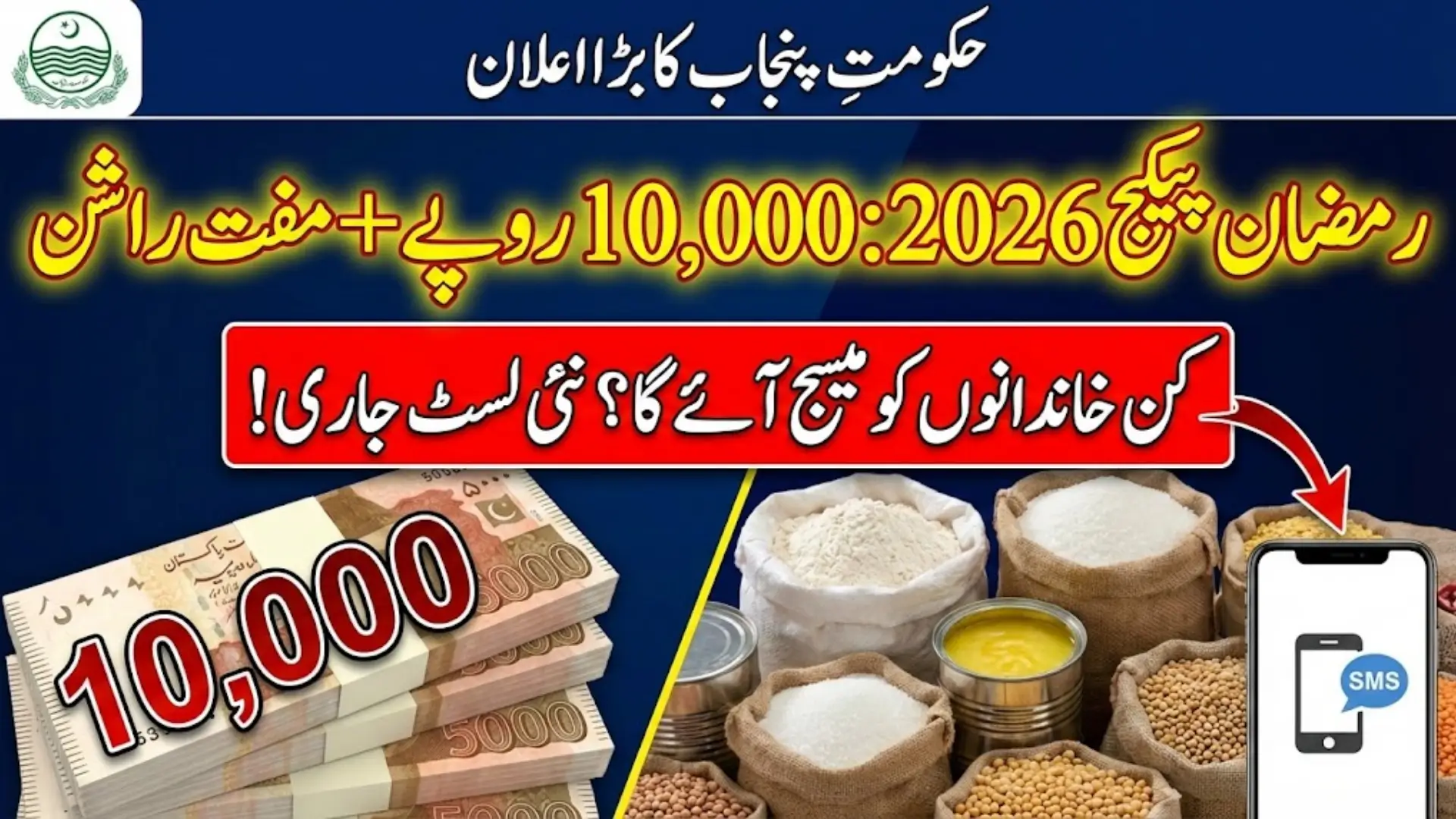
PSER Survey Ramzan Package 2026
PSER Survey Ramzan Package 2026 provincial administration has shifted to a data-driven system for Ramzan assistance, making socio-economic registration the foundation of eligibility. Officials observed in previous years that many deserving families were missed because household records were incomplete or outdated. To address this gap, relief approval is now linked directly to verified poverty data collected across districts.
On-ground observations at registration desks and Union Council offices show strong public response, especially from daily wage earners and low-income households who rely on seasonal support to manage kitchen expenses. The relief initiative is supervised by the Punjab Government to ensure that distribution follows a transparent and standardized process across the province.
The approach aims to reduce manual selection, eliminate duplication, and ensure that financial assistance and food support reach only those families whose economic condition qualifies them for public welfare.
You Can Also Read: Premium Prize Bond 25000 Result 2026
Nature of Financial Aid and Household Food Support
The Ramzan assistance structure combines direct cash support with essential food supplies. This dual approach reflects the real financial pressure faced by Pakistani households, where grocery expenses consume a major portion of monthly income, especially during Ramzan.
Authorities designed the package to provide immediate relief rather than symbolic support. The cash component allows families to manage daily expenses such as vegetables, utilities, and medicines, while the ration package ensures basic food security throughout the holy month.
Eligible families will receive support in the following form:
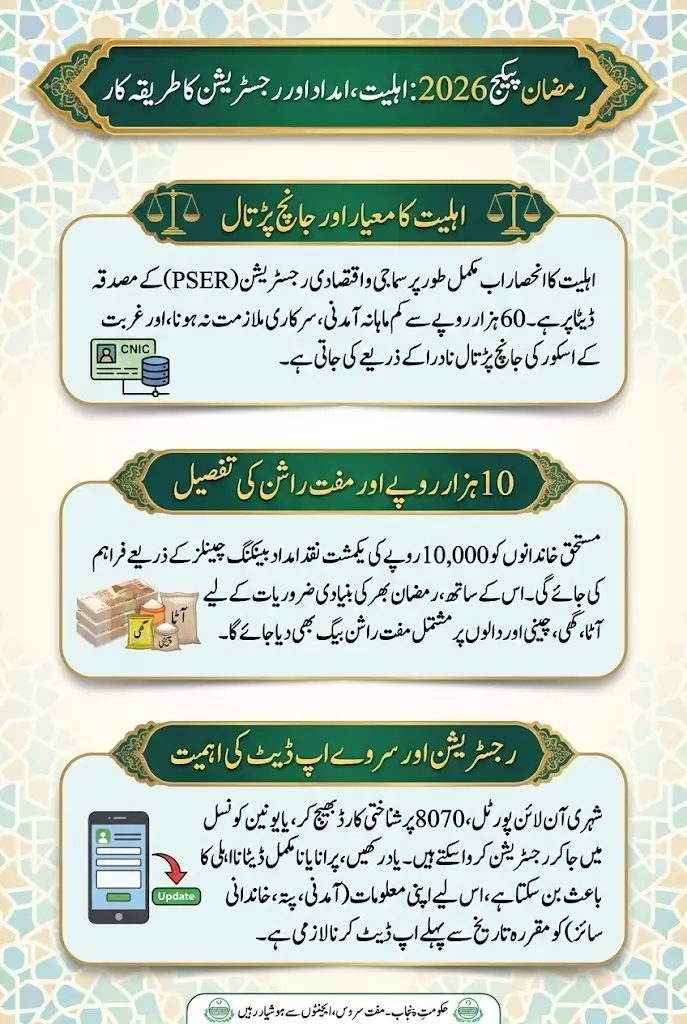
- One-time cash assistance of Rs. 10,000
- Free ration bag containing atta, ghee, sugar, and pulses
- Official notification after successful verification
- Distribution through secure and trackable payment channels
This integrated support structure aims to reduce borrowing and help households maintain dignity during difficult economic conditions.
Practical Registration Channels Available for Citizens
To ensure accessibility for both urban and rural populations, authorities introduced multiple registration options. The system has been designed to accommodate individuals with limited internet access, low literacy levels, or mobility challenges.
Field visits reveal that many citizens prefer in-person registration because officials help them complete forms and verify details immediately. However, digital and SMS options provide faster processing for those comfortable with technology.
Citizens can complete their socio-economic registration through:
- Online portal using CNIC and registered mobile number
- SMS eligibility check by sending CNIC to 8070
- Physical registration at Union Council or relief desks
- Door-to-door surveys conducted in selected areas
Each method feeds data into the same central registry, ensuring equal consideration regardless of registration channel.
You Can Also Read: Ramzan Nighban Program 2026 New Qist 10000
Socio-Economic Standards Used to Determine Eligibility
Eligibility is not decided randomly but calculated through a structured poverty assessment framework. Household income, employment status, and asset ownership are evaluated to determine whether a family falls within the defined assistance category.
Officials repeatedly emphasize that incorrect or outdated information may result in disqualification even if the household is financially deserving. Families are therefore encouraged to provide accurate and complete details during the survey process.
The following criteria are used to assess eligibility:
- Permanent residence within Punjab province
- Monthly household income below Rs. 60,000
- Poverty score within approved threshold
- No government employee in the household
- Absence of luxury assets or large-scale business ownership
These conditions ensure that limited public funds are directed toward households facing genuine financial hardship.
You Can Also Read: Parwaz Card Loan Scheme 2026 – 0% Interest Youth Business
Verification Mechanism and Approval Procedure
After submission, household data undergoes a systematic verification process to ensure authenticity and prevent duplication. Identity records are matched with national databases, and socio-economic indicators are cross-checked to confirm eligibility status.
This verification system operates with technical support from NADRA, which helps authenticate identity records and maintain database accuracy. Once verification is completed, eligible families receive an official confirmation message containing details of payment collection.
The verification workflow typically involves:
- Identity authentication through national records
- Household income and asset verification
- Eligibility confirmation through SMS notification
- Assignment of payment location and collection date
This structured procedure enhances public trust by ensuring fairness and transparency in distribution.
You Can Also Read: Maryam Nawaz Ramazan Bazaars 2026 Nigehban
Transparent Payment and Distribution Framework
Instead of traditional cash handouts, authorities have introduced a secure financial distribution system to minimize irregularities. Beneficiaries collect funds through formal banking channels, reducing the risk of mismanagement and unauthorized deductions.
Banking facilities across Punjab have been integrated into the distribution mechanism to provide safe and convenient withdrawal options for beneficiaries.
Financial assistance can be collected through:
- ATM withdrawal using assigned relief card
- Designated distribution centers
- Biometric verification using original CNIC
The disbursement process is coordinated with the Bank of Punjab, ensuring reliable and traceable payment delivery.
You Can Also Read: CM Punjab Honhar Laptop Scholarship 2026
Households That Should Update Their Survey Without Delay
A significant number of applicants are excluded each year due to outdated or incomplete information rather than financial ineligibility. Families experiencing changes in income, residence, or household size must update their records to remain eligible for assistance.
During interactions with registration officials, it became evident that newly married couples, migrant workers, and tenants often remain unregistered due to lack of awareness. Updating survey data ensures continued inclusion in welfare programs.
Households should update their registration if:
- They were never registered in a welfare database
- Household income has changed
- Family size increased or decreased
- Residence has shifted to a new location
- Previous eligibility status was rejected
Accurate information strengthens eligibility not only for Ramzan relief but also for future government support programs.
You Can Also Read: Winning Numbers for 100 Prize Bond Karachi
Registration Timeline and Its Effect on Benefit Distribution
Authorities announced a fixed registration deadline for the current Ramzan relief cycle. Families completing registration before the closing date are included in the 2026 distribution phase, while late applicants remain recorded for future welfare initiatives.
Timely registration allows officials to finalize beneficiary lists, arrange ration logistics, and schedule payments without administrative delays. Missing the deadline does not cancel eligibility permanently but postpones access to assistance.
Below is a simplified overview of the relief process timeline:
| Process Stage | Outcome for Applicant |
|---|---|
| Survey completed before deadline | Included in Ramzan 2026 relief |
| Late survey submission | Added to welfare database for future programs |
| Successful verification | Payment notification issued |
| CNIC biometric confirmation | Funds released to beneficiary |
This structured cycle helps manage large-scale distribution efficiently across districts.
Official Support Services and Public Guidance
To assist citizens facing technical or eligibility issues, a dedicated helpline and support mechanism have been established. Officials strongly advise applicants to avoid agents who demand payment for registration services, as the entire process is free of cost.
Public service representatives are available to guide citizens regarding registration errors, verification status, and payment collection procedures. Clear communication between authorities and citizens is considered essential for smooth implementation.
Citizens may seek assistance for:
- Registration process guidance
- Incorrect eligibility status
- Payment delays or technical issues
- Verification or biometric problems
Accessible support services strengthen public confidence and ensure that deserving families are not excluded due to procedural challenges.
Long-Term Importance of Socio-Economic Registration
The socio-economic registry has evolved into the central gateway for provincial welfare programs. Beyond Ramzan assistance, the database is expected to determine eligibility for future subsidies, financial aid, and social protection initiatives.
For many low-income households, maintaining updated records represents long-term security rather than one-time relief. Families that remain active in the registry are more likely to benefit from future support programs designed to address inflation and rising living costs.